
Japan reaches out to Vietnam amid soaring rice prices
(NLĐO) - Vietnamese rice exported to Japan currently faces a 400% tariff and numerous stringent technical barriers.
Speaking to Nguoi Lao Dong Newspaper recently, Do Ha Nam, chairman of the Vietnam Food Association (VFA), said prospects for expanding rice exports to Japan are improving, as retail prices there hit record highs despite Vietnam’s recent export difficulties.
Four key areas of interest
On December 5, Fumiko Yagihashi, Deputy Director of the Food Security Office under the Policy Planning Department and Secretary to the Minister of Japan’s Ministry of Agriculture, Forestry and Fisheries, visited and held working sessions with the VFA to discuss agricultural cooperation between the two countries.
The Japanese delegation highlighted four key areas of interest.
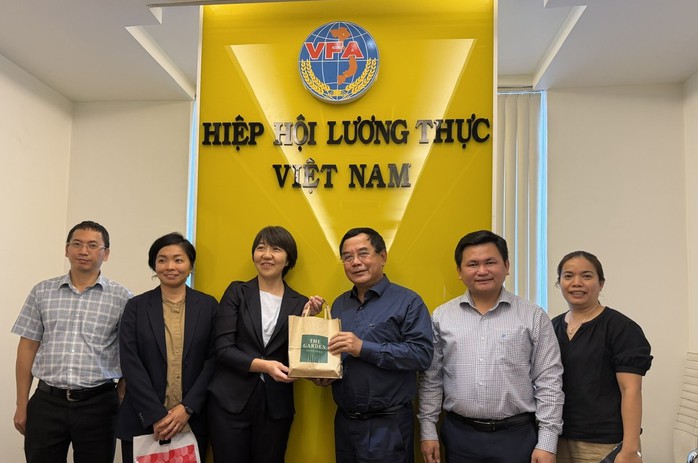
Ms. Fumiko Yagihashi (third from left), Deputy Director of the Food Security Office under the Policy Planning Division and Secretary to the Minister of Agriculture, Forestry and Fisheries of Japan, visited and worked with the VFA. Photo: VFA
First, the role of the VFA in Vietnam’s rice industry.
Second, Vietnam’s food security policies outlined in Government Decision No. 583/QD-TTg on the rice export market development strategy to 2030, which includes a plan to reduce annual export volumes to 4 million tonnes from the previous 7–9 million tonnes.
Third, the production of high-quality rice within the sector’s value chain.
Fourth, climate change impacts on rice production and the implementation of the 1-million-hectare project for high-quality, low-emission rice tied to green growth in the Mekong Delta.
The VFA proposed partnering with Japan to develop specialized rice cultivation zones in Vietnam, using Japanese varieties, processes, and technologies. Rice produced in these zones would be exported back to Japan, meeting its stringent technical and quality standards.
The association also requested that Japan ease conditions for importing Vietnamese Japonica rice and ST25 rice to serve the more than 600,000 Vietnamese citizens living and working in Japan.
According to Nam, Vietnamese rice entering Japan currently faces a 400% import tax along with strict technical and quality controls, keeping export volumes extremely limited.
“If Japan cooperates in rice production in Vietnam, it could secure food supplies at a lower cost, while Vietnamese farmers would benefit from better selling prices. Ms. Fumiko Yagihashi has taken note of these proposals and will report them to the relevant authorities,” Nam said.
He described the meeting as a strategic step that could help unlock the Japanese market for Vietnamese rice through mutually beneficial collaboration.
Average rice prices at Japanese supermarkets have climbed to a record 5.6 USD per kilogram (around 147,000 VND). Meanwhile, Vietnam’s average export price is only 512 USD per tonne—less than one-tenth of Japan’s retail level—down 18.3% year-on-year.
As of the end of November 2025, Vietnam had exported 7.5 million tonnes of rice worth 3.83 billion USD, down 11.5% in volume and 27.7% in value from the same period last year.