
Newly elected Prime Minister Le Minh Hung outlines five priorities for government
(NLDO) - Prime Minister Le Minh Hung unveiled a five-point agenda designed to propel Vietnam into a new era of rapid, sustainable, and inclusive development.
Speaking shortly after his inauguration on April 8, Prime Minister characterized the 2026–2031 term as a "historic window of opportunity" guided by the vision of the 14th National Party Congress.
He outlined five overarching priorities for the government: building a modern, enabling and people-centred administration; steering the economy towards high and sustainable growth; ensuring the effective operation of the new organisational model; fostering a united, coordinated and supportive government; and promoting integrity, discipline, resilience and accountability.
The newly elected government leader said top priority would be given to developing and perfecting a coherent institutional framework, including a sweeping review and synchronised amendment of legal regulations, drastic cuts to administrative procedures, and the removal of bottlenecks to unlock all social resources. The goal is to establish a lean, strong, effective and efficient apparatus guided by a proactive, action-oriented approach.
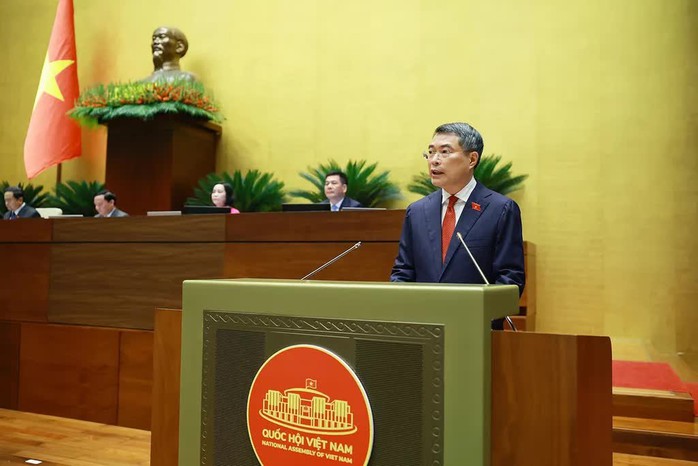
Prime Minister Le Minh Hung gave the inaugural address on April 7 in front of the National Assembly. - VNA/VNS Photo
Reaffirming his determination to deliver high and sustainable economic growth, Hưng described an average GDP growth target of over 10 per cent annually for 2026–31 as a development imperative to realise the country’s strategic goals.
The government identified science and technology, innovation and national digital transformation as the foremost breakthroughs and key drivers for advancing modern productive forces, boosting productivity and competitiveness, and strengthening strategic autonomy.
These efforts would create new growth engines, support the development of synchronised and modern infrastructure, accelerate the green transition, and enhance resilience to climate change.
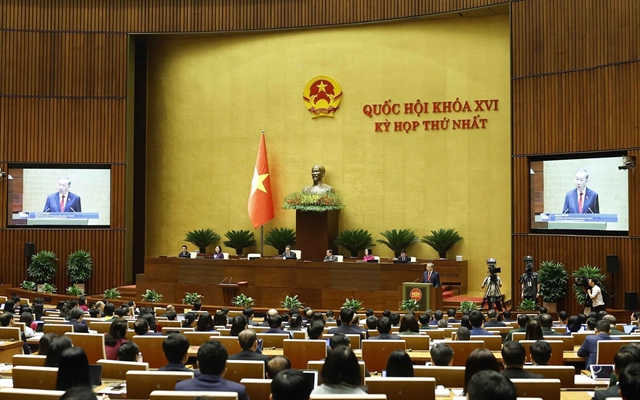
The state-owned economy would continue to play a leading role, while the private economy is expected to become the most important growth driver, ensuring all localities, businesses and citizens have opportunities to contribute to and benefit fairly from development.
Viewing investment in people as the most sustainable investment for the future, the government would allocate appropriate resources to reform education and training, develop a highly skilled workforce and attract talent. It would strengthen the public healthcare system, improve grassroots-level services and ensure universal access to quality health care, according to PM Hung.
Social welfare policies would be effectively implemented, with greater support for vulnerable groups and those who have contributed to the nation, ensuring no one is left behind.
The government would also aim to develop culture into a solid foundation and an intrinsic strength of the nation, affirming the identity and standing of Vietnamese culture befitting a developed country with a long-standing civilisational tradition.
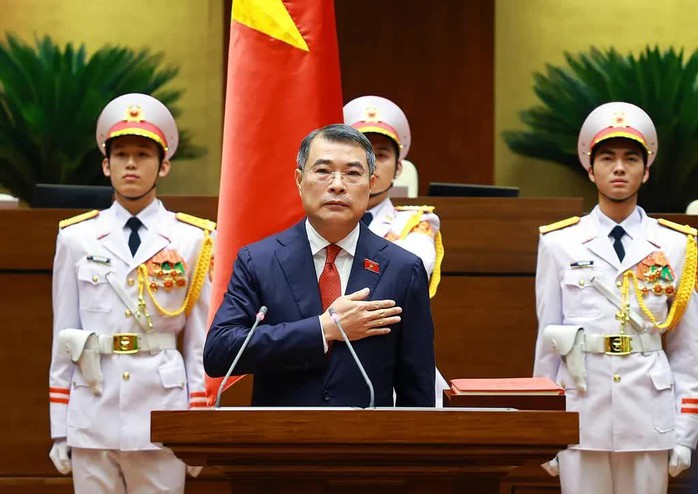
Prime Minister Le Minh Hung took the oath of office. — VNA/VNS Photo
At the same time, it would reinforce national defence and security, build a robust all-people defence posture linked with a strong people’s security framework, and pursue a consistent foreign policy of independence and self-reliance, while promoting economic and technological diplomacy to elevate Vietnam’s international standing.
On building a united, coordinated and supportive government, PM Hung stressed that state power must remain unified while ensuring clear division, coordination and oversight among legislative, executive and judicial bodies.
The government would work closely with Party bodies in institutionalising and implementing Party guidelines; with the National Assembly in lawmaking; with the Vietnam Fatherland Front and socio-political organisations in understanding public sentiment; and with local authorities in resolving bottlenecks, mobilising resources and driving development.
To build a government characterised by integrity, discipline, resilience and accountability, the new PM said "public trust is the nation’s greatest asset". Rapid development would require a clean administrative system, upright officials and strict discipline.
The government would be committed to acting with the highest determination, placing national and public interests above all else, intensifying efforts against corruption, wastefulness and misconduct, tightening administrative discipline, strengthening accountability of leaders and ensuring strict control of power.
He also pledged firm action against indifference and avoidance of responsibility in addressing the difficulties faced by citizens and businesses, while effectively implementing mechanisms to encourage and protect officials willing to take initiative, innovate and assume responsibility for the common good.
Six Deputy Prime Ministers
To help translate this ambitious mandate into action, the new-term Government will have six Deputy Prime Ministers: Pham Gia Tuc, Phan Van Giang, Pham Thi Thanh Tra, Ho Quoc Dung, Nguyen Van Thang and Le Tien Chau.
Of the six, four are first-time appointees to the post - Pham Gia Tuc, Phan Van Giang, Nguyen Van Thang and Le Tien Chau.
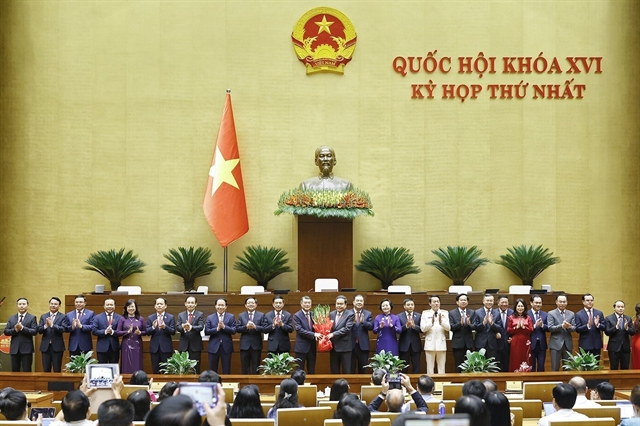
National Assembly Chairman Tran Thanh Man presents flowers to congratulate the Prime Minister, Deputy Prime Ministers, Ministers and other members of the Government for the 2026-31 term. — VNA/VNS Photo
The appointments were announced after the 16th National Assembly on the morning of April 8 passed a resolution approving the Prime Minister’s nominations for Deputy Prime Ministers for the 2026-31 term.
A total of 485 deputies (97 per cent of all members) took part in the vote, with 484 voting in favour (96.3 per cent of all deputies). One deputy abstained.
Pham Gia Tuc
Born in 1965 in the northern province of Ninh Bình, Pham Gia Tuc holds an advanced degree in political theory and a Master’s in Public Administration, alongside bachelor’s degrees in Administration and Foreign Economic Relations.
He is a member of the 14th Politburo and a Secretary of the Party Central Committee for the same term, as well as a member of the 13th and 14th Party Central Committee and a deputy of the 16th National Assembly.
Over the course of his career, he has served as Deputy Secretary of the Can Tho Party Committee; Deputy Head of the Party Central Committee’s Commission for Internal Affairs; Secretary of the Nam Dinh Provincial Party Committee; Deputy Chief of the Party Central Committee’s Office; and Chief of the Party Central Committee’s Office (since August 2025). He has also been Permanent Deputy Head of the Central Steering Committee for the Development of Science, Technology, Innovation and Digital Transformation (since August 2025).
Phan Van Giang
Born in 1960 in the northern province of Ninh Binh Province, Phan Van Giang holds an advanced degree in political theory and a doctorate in Military Science.
He is a member of the 13th and 14th Politburo, a member of the 12th, 13th and 14th Party Central Committee, and a deputy of the 15th and 16th National Assembly. He is also a member of the Standing Committee of the Government Party Committee, Deputy Secretary of the Central Military Commission, a General (since July 2021), and Minister of National Defence (since April 2021).
Pham Thi Thanh Tra
Born in 1964 in the central province of Nghe An, Pham Thi Thanh Tra holds an advanced degree in political theory, a Master’s in Educational Management and a bachelor’s degree in Philology.
She is a Secretary of the 14th Party Central Committee, a member of the 12th, 13th and 14th Party Central Committee, and a deputy of the 15th and 16th National Assembly.
Her previous roles include Secretary of the Yen Bai Provincial Party Committee and Chairwoman of the provincial People’s Council; Minister of Home Affairs; Deputy Head of the Party Central Committee’s Organisation Commission; and Deputy Prime Minister.
Ho Quoc Dung
Born in 1966 in the central province of Gia Lai, Ho Quoc Dung holds an advanced degree in political theory and a Master’s in Law.
He is a member of the 13th and 14th Party Central Committee and a deputy of the 12th National Assembly.
His career posts include Chairman of the Bình Định Provincial People’s Committee; Secretary of the Binh Dinh Provincial Party Committee and Chairman of the provincial People’s Council; Secretary of the Gia Lai Provincial Party Committee; and Deputy Prime Minister.
Nguyen Van Thang
Born in 1973 in Ha Noi, Nguyen Van Thang holds an advanced degree in political theory, a doctorate in Economics, a Master’s in Monetary Circulation, and a bachelor’s degree in Finance and Credit.
He is a member of the 12th (alternate), 13th and 14th Party Central Committee and a deputy of the 14th, 15th and 16th National Assembly.
He has previously served as Chairman of the Board of Directors of VietinBank; Chairman of the Quang Ninh Provincial People’s Committee; Secretary of the Dien Bien Provincial Party Committee; Minister of Transport; and Minister of Finance.
Le Tien Chau
Born in 1969 in the southern province of Tay Ninh, Le Tien Chau holds an advanced degree in political theory and a doctorate in Law.
He is a member of the 13th and 14th Party Central Committee and a deputy of the 15th National Assembly.
His past roles include Secretary of the Hau Giang Provincial Party Committee and Chairman of the provincial People’s Committee; Deputy Chairman and Secretary-General of the Central Committee of the Vietnam Fatherland Front; and Secretary of the Hai Phong Municipal Party Committee.