






Amid projections of reduced global rice supplies, many experts suggest this could be an opportunity for Vietnam's rice sector to improve export prices in the final months of the year.
However, to capitalize on this opportunity, enterprises must reduce their dependence on a few major markets and enhance their capacity to regulate supply.
Exports surge, but...
According to the Ministry of Agriculture and Environment, in May 2026, Vietnam exported approximately 1.1 million tons of rice, earning $511.7 million. Accumulated over the first five months of the year, rice exports reached 4.5 million tons with a turnover of $2.09 billion.
Despite the high volume, the export value decreased by 3.6% compared to the same period in 2025 because the average export price was only $467.6 per ton, a drop of 9.6%.
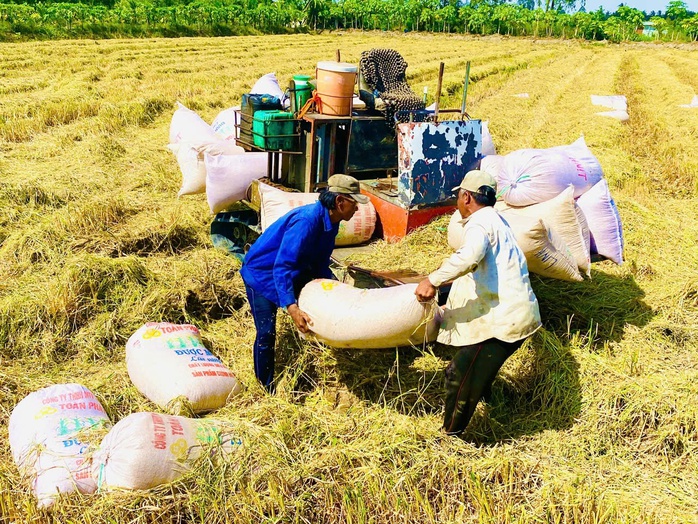
Rice harvesting in the Mekong Delta. Photo: LÊ HOÀNG VŨ
The Philippines remains Vietnam's largest rice consumption market, accounting for 46.9% of the market share, while China ranks second at 17.8%. However, both markets enforce strict import management mechanisms, frequently leaving Vietnamese enterprises in a passive position.
Specifically, China manages rice imports through quotas and a list of licensed export enterprises. Currently, only about 40 Vietnamese enterprises are permitted to export rice to this market, whereas the country has over 150 businesses holding rice export licenses. Meanwhile, the Philippines governs imports through a licensing mechanism and policies that regulate the volume of imported rice in phases.
According to the Vietnam Food Association (VFA), whenever reports emerge that the Philippines might reduce imports, many domestic enterprises often ramp up sales to maintain market share and clear inventory. Flooding the market with supply in a short period causes rice prices to plummet, with farmers bearing the brunt of the impact.
The director of a rice export firm in Tay Ninh confirmed that despite record export volumes, both farmers and many enterprises have yet to truly benefit. This is because numerous companies signed export contracts when selling prices were low. In some instances, enterprises lost nearly 2,000 VND per kilogram of exported rice.
Conversely, intermediaries are believed to be profiting more due to the margin between the purchasing price from farmers and the selling price to exporters.
Rice prices trend toward recovery
According to the U.S. Department of Agriculture (USDA), global rice production for the 2026-2027 crop year will reach only 537.8 million tons, down about 5 million tons from the previous season. Meanwhile, continuing growth in consumption demand is projected to drive global inventories down to approximately 192.7 million tons.
The USDA did not specify the reasons for the production decline. However, according to experts, many rice-producing nations are adjusting their output following a prolonged period of low prices.
Meanwhile, Phan Mai Huong, co-founder of SSResource Media Pte. Ltd (Singapore), suggested that the risk of a strong El Niño emerging in the final months of the year could leave many key rice-producing regions facing water shortages.
Notably, although the year-end is not Vietnam's peak production period, it is a crucial season for many rice-exporting countries in the region. Should production in these nations plummet, global rice supplies will be substantially affected.
Furthermore, production costs - particularly fertilizers and logistics - remain high. This prompts many farmers to consider reducing the number of annual crop cycles as the economic viability is no longer as attractive as before.
Nguyen Van Thanh, Director of Phuoc Thanh IV Production - Trading Co., Ltd. (Vinh Long), stated that escalating production costs are driving many localities to gradually shift from a three-crop to a two-crop annual farming model.
This trend could curtail supply in the coming years, thereby contributing to tighter global market supplies. And upon perceiving the risk of a global supply shortage, importing nations will proactively increase purchases to ensure food security, subsequently supporting rice prices at higher levels.
Decentralizing fragrant rice certification to localities
Effective July 1, 2026, the certification and recertification of fragrant rice varieties for export - eligible for tariff preferences under the EU-Vietnam Free Trade Agreement (EVFTA) and the UK-Vietnam Free Trade Agreement (UKVFTA) - will be decentralized to provincial People's Committees.
Previously, the authority to issue certificates for fragrant rice varieties to qualify for quota-based import tax exemptions rested with the Ministry of Agriculture and Environment. Under the new regulations, this authority is transferred to the chairpersons of provincial and municipal People's Committees.
The Ministry of Agriculture and Environment has requested localities to step up communications and disseminate the new regulations to management agencies, enterprises, and citizens to ensure a smooth implementation process. Concurrently, localities must submit the signature samples of the authorized individuals responsible for validating the certification and recertification of fragrant rice varieties, along with the official seal of the executing agency, to the Ministry of Agriculture and Environment. This is for consolidation and subsequent notification to the European Union (EU) and the United Kingdom, in accordance with regulations.
Th.Linh



 và quét mã QR
Bạn không thể gửi bình luận liên tục. Xin hãy đợi
60 giây nữa.