






The National Assembly recently voted to approve a resolution amending and supplementing a number of articles of Resolution No. 81/2023/QH15 on the National Master Plan for the 2021–2030 period, with a vision to 2050. The Resolution takes effect upon adoption by the National Assembly.
Specific economic targets
The Resolution sets forth specific economic targets, including an average annual GDP growth rate of over 8.0% for the 2021–2030 period, with growth of at least 10% annually during 2026–2030. By 2030, GDP per capita at current prices is projected to reach approximately USD 8,500.
The services sector is to account for over 50% of GDP, industry and construction over 40%, and agriculture–forestry–fisheries below 10%.
Average annual labour productivity growth is targeted at around 7% during 2021–2030, rising to over 8.5% during 2026–2030. Total factor productivity (TFP) is expected to contribute more than 55% to overall growth.
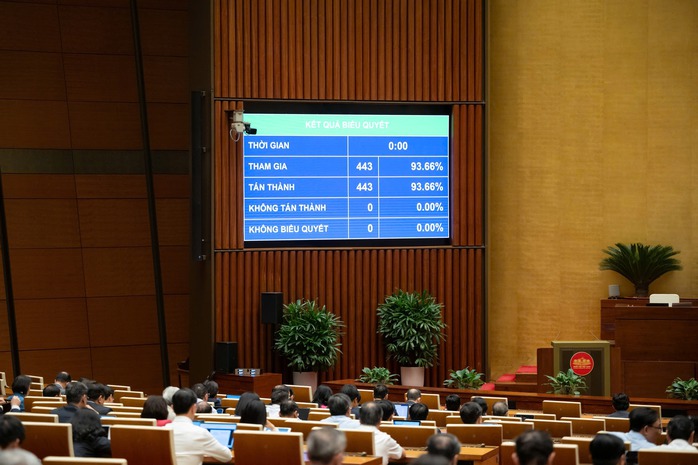
On December 10, the National Assembly voted to approve a resolution adjusting the National Master Plan for the 2021–2030 period, with a vision to 2050
The Resolution calls for leveraging the comparative advantages of each socio-economic region; prioritising the development of the two growth-driving zones in the North and the South associated with the two major growth poles—Hanoi and Ho Chi Minh City; and advancing the North–South economic corridor, the Lao Cai–Hanoi–Hai Phong–Quang Ninh economic corridor, and the Moc Bai–Ho Chi Minh City–Bien Hoa–Vung Tau economic corridor with modern, synchronised infrastructure, high growth rates, and strong contributions to national development.
The Resolution establishes a national development spatial framework consisting of six socio-economic regions and mandates the design of regional governance models and coordination mechanisms to strengthen intra-regional linkages and promote cross-regional cooperation, thereby improving the efficiency of resource utilisation.
Most significant growth engine
In this framework, the Southeast Region - including Ho Chi Minh City, Dong Nai and Tay Ninh provinces - targets an average GRDP growth rate of around 10-11% per year for the 2026–2030 period.

The Southeast Region is to be developed into a dynamic region with high economic growth, serving as the country’s most significant growth engine; a centre for science, technology and innovation, high-tech manufacturing, logistics, and a highly competitive international financial hub in the region; and a leader in transforming the growth model and advancing digital transformation.
The region will drive connectivity and spillover effects through the North–South economic corridor, the Central Highlands–Southeast economic corridor, and the economic corridor along National Highway 13 from Ho Chi Minh City to Dong Nai. It will expand the industrial–urban chain from Moc Bai to Ho Chi Minh City to the Cai Mep–Thi Vai Port Complex, aligned with the Trans-Asian economic corridor.
Key transport priorities include building expressways connecting Ho Chi Minh City with provinces within and beyond the region, and completing Ring Roads No. 3 and No. 4 of Ho Chi Minh City.
Ho Chi Minh City will be developed into a civilised, modern, innovative metropolis; an international financial centre; a city with a prominent position in Southeast Asia; and one that stands on par with major urban centres across Asia.
Urban rail projects in Ho Chi Minh City will be expanded, including rail links between the city centre and neighbouring urban areas. New railway lines will be built to connect major seaports and international gateway airports.
The Long Thanh International Airport will be completed, brought into operation, and fully integrated with connecting transport systems. An international transshipment port in Can Gio will be developed.
Airport operations at Tan Son Nhat and Long Thanh, as well as port operations at the Cai Mep–Thi Vai complex and the Hiep Phuoc and Cat Lai port areas, will be coordinated to ensure optimal efficiency.



 và quét mã QR
Bạn không thể gửi bình luận liên tục. Xin hãy đợi
60 giây nữa.